How to Integrate Razorpay With Your Online Store

It's 2 a.m. and a founder has just pasted their Razorpay Key ID into an .env file inside a Lovable project. The build passes. A test payment goes through. Then they close the laptop, because the guide they followed ends there — at the moment the checkout works, not at the moment anyone actually finds it.
You built the store prototype on Lovable or Bolt. The product pages render, the cart works, the design doesn't embarrass you. What you don't have yet is anyone finding the store, trusting it enough to enter a card number, or coming back after the first purchase. Razorpay integration matters here — but only if you treat it as one piece of a system, not the whole project.
Why Razorpay integration fails for prototype-to-production founders
Most integration guides are written for developers at companies that already have customers, already have traffic, and already have someone answering "where's my order" emails by hand. They assume traffic. They assume trust. They assume a support team already exists to catch what falls through. A founder shipping their first product from a prototype builder has none of those yet — the payment gateway is often the first real piece of infrastructure they touch, and most guides treat it as a checkbox instead of the foundation it actually is.
That's the gap. A Key ID and Key Secret dropped into the right fields will process a transaction. They will not make a stranger trust an unfamiliar checkout page enough to type in a card number. They will not make that page appear when someone searches for the product category. And they will not answer the question a hesitant buyer types into a chat box thirty seconds before they would otherwise close the tab. Those three problems — payments, discovery, and support — used to arrive in a business one at a time, spaced out over years of growth. For someone shipping a prototype into production today, they arrive on the same afternoon.
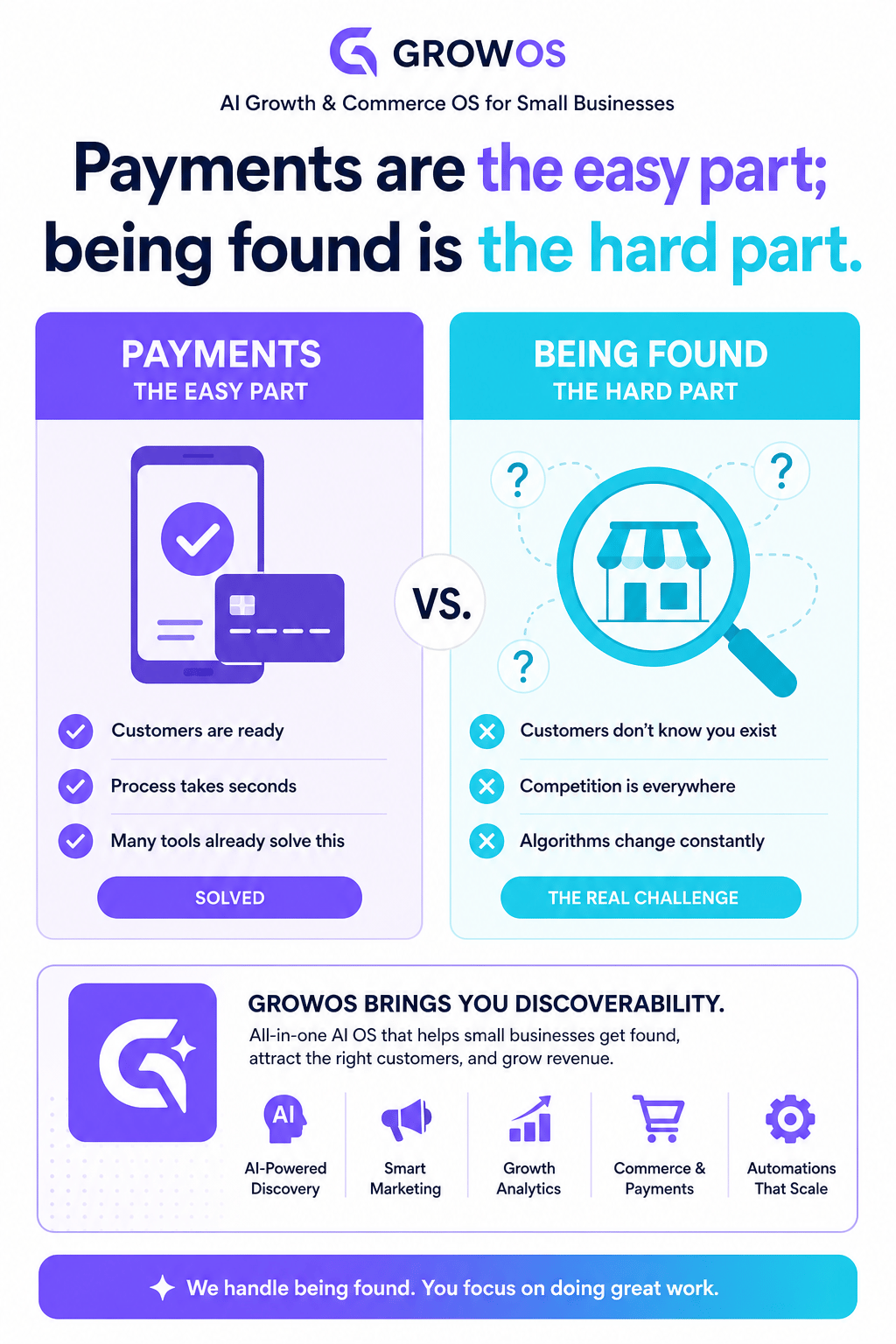
Payments are the easy part; being found is the hard part
A working checkout that nobody reaches is not a store. It's a form. The founders who treat Razorpay integration as the finish line usually discover this a few weeks in, when the payment logs are empty not because the gateway failed but because no one landed on the page in the first place.
This is also the moment where payments and search are quietly merging into the same problem. Search engines are no longer just pointing at storefronts — they are starting to complete the purchase themselves. Google has begun rolling out instant checkout inside AI Mode and the Gemini app, built on a Universal Commerce Protocol it co-developed with Shopify Vogue. That is a signal worth taking seriously for anyone building a store right now: the line between "getting found" and "getting paid" is disappearing at the platform level, not just at the level of good practice. A checkout page that isn't structured to be legible to search and AI discovery systems is a checkout page that will increasingly sit outside the paths customers actually take to buy.
For a founder moving a prototype to production, that means SEO fundamentals — clean product schema, indexable pages, fast load times on the checkout flow itself — aren't a later-stage marketing task bolted on after launch. They need to be part of the same build that wires in the Razorpay keys, because the systems that route buyers to a store and the systems that process their payment are converging into one flow, not two.
The chatbot isn't a bonus feature, it's the support team you don't have
The second gap shows up right before checkout, not after it. A buyer with one unanswered question — does this ship internationally, does this size run large, is this refundable — will not email a support inbox and wait. They'll leave. A founder without a support team yet doesn't have a person to catch that moment. What they can have is a chatbot that catches it instead, answering the question in real time and keeping the customer moving toward the payment page that Razorpay is about to process.
This isn't a novelty add-on anymore. AI has already reshaped screen-based work — drafting, summarizing, answering — and it is moving quickly into an agentic era, where it completes end-to-end tasks on its own rather than just assisting with them Mckinsey. A checkout-adjacent chatbot sits squarely inside that shift: it isn't a decoration on the store, it's the connective tissue between a stranger's question and a completed transaction. Treating it as a launch-week nice-to-have, rather than part of the same infrastructure as the payment gateway, is how stores end up with working checkouts and empty payment logs.
Building it in the right order
None of this means a founder needs a payments team, an SEO agency, and a support department before taking a single order. It means the three pieces have to be planned as one system from the start, even if each piece is simple on day one. A Razorpay integration wired in alongside indexable product pages and a chatbot that can answer the five questions buyers ask most often is a materially different launch than a checkout page shipped alone and improved later.
The order matters because retrofitting is expensive in a way that founders underestimate. Adding SEO structure to a store after launch means re-architecting pages customers and search engines have already partially indexed. Adding a support chatbot after a few hundred abandoned carts means guessing, after the fact, at questions you could have simply asked upfront. Adding payment logic last, once the store already has traffic and trust, is the only one of the three that's actually easier to bolt on later — which is exactly backward from how most guides sequence the work.
A generic integration guide will get the payments right. It will not tell you that the checkout page it's describing also has to be found, and also has to answer a question, on the same day it goes live. Build all three into the same launch, and the store a prototype becomes isn't just accepting payments — it's ready for the customer who was never going to email support in the first place.
Have questions or ready to get started?
Get in touch with Tyashin